IS OUR CARE CONDITIONAL?
You step onto the beaches of Sardinia, Italy, ready to capture paradise.
Each picture holds a hidden reality. They invite you to look past the beautiful scenery and discover the stories of impact written in it. Each photograph captures a moment where human presence alters the natural world. Each image forced me to question our current reality and wish that the care we show on the water remained with us on land.
I chose this iconic destination because its fragile ecosystem faces extreme pressure from tourism, turning a personal vacation into a harsh observation of human impact.
Is our care for nature only active when we’re standing in it?


This project looks below the surface of Sardinia’s coast to show
a hidden problem: delicate sea life struggling under human pressure.
Each photo reveals the gap between our love
for nature and the damage we cause.

CALA CORSARA
Cala Corsara is one of the most popular places in the Archipelago della Maddalena. Renowned for its white sand, emerald waters, and granite rocks, it can only be reached by sea.
These pictures were taken at the start of June 2026, the beginning of the high season.

While taking these photos, I wondered: if it is this crowded now, off-season,
how many people will fill this space during the summer rush?
Visitors and tour companies note that at any given
moment during the midday high-season rush. there are
easily 300 to 500+ people sharing the sand
simultaneously (an estimation of 70 to 120+ boats).
When renting a boat, you receive aspecific briefing about how to anchor the boat.
They will emphasize that you
CANNOT anchor anywhere you want.
(In Cala Corsara and the surrounding islands, you must anchor behind the designated line of colored buoys to protect the underwater seagrass, Posidonia, and keep the swimming zones safe.
But my question was... do all these 70 to 120+ boats follow the rules?
Would they all care about Poseidonia?
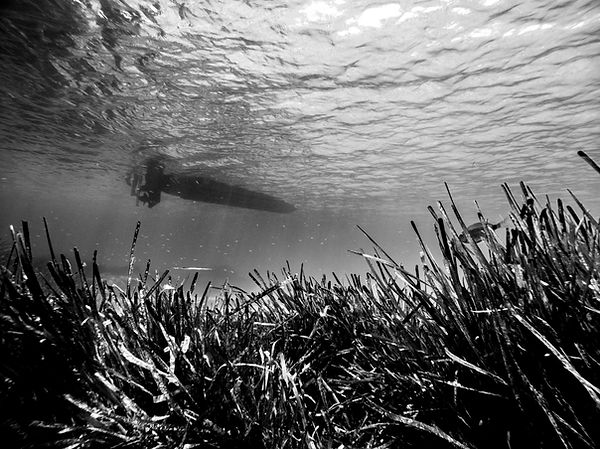
Boats are a major threat to Posidonia oceanica in Sardinia. The slow-growing seagrass, often called the "lungs of the Mediterranean," is routinely damaged by boat anchors and anchor chains tearing through its roots and leaves.
Turning the image upside down forces us to look at what is usually hidden. The Posidonia grass stays underwater, out of sight, yet it acts as the lungs of the coast, creating oxygen and holding the seabed together.

On the boat, everyone was careful to use biodegradable soap and shampoo. But it made me wonder:
Why do people only care when they’re right next to the water? On land, that same care often disappears.
Proximity creates empathy; when we see the direct impact of our actions, we change.
The real challenge is: how do we build that same sensitivity when the consequences aren’t immediately visible?

People protect the sea when they’re in it, but why don’t they have the same care at home? This picture shows performative activism: caring for nature only when it’s in front of their eyes. Is our care conditional?
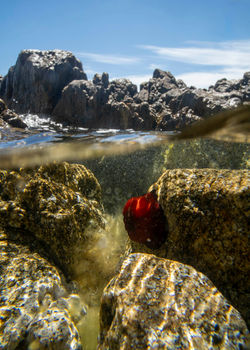
Actinia equina
 |  |
|---|
These anemones act like a warning system. When they shrink or die, It is a clear sign that the climate is breaking down.
Marine biologists studying Actinia equina in the Mediterranean have found that when water temperatures rise above 25°C, the anemones' metabolism skyrockets, causing them to burn energy too fast and physically shrink in size.
Their pain warns us that the ocean is getting too hot.
This split-level view reveals a thriving underwater garden clinging to the rocks with brown and green algae that signal
a healthy, oxygen-rich sea. Fan-shaped Peacock’s Tail and delicate Sea Umbrella algae colonize the shallow, clear waters, painting a portrait of marine life in balance. Above, the sunlit coast hints at the world we share; below, nature’s quiet resilience thrives, if we choose to protect it.
The underwater grass
These wooden fences help
rebuild dunes
by tourism
that have been worn down

Many people started taking away
so much sand that it became a problem.
According to the locals, there have been
stories of some tourists who wanted to go
all the way to the top,
but instead of going on foot, they went
by car. By doing so, they destroyed all the dunes' vegetation, and locals were furious.
How can someone be so careless and selfish
to do such a thing?
In May 2026, a French tourist was intercepted at
Porto Torres with 40kg of sand, pebbles, and shells packed into her vehicle.
Another couple was caught attempting to smuggle
14 plastic bottles of sand
to decorate their home aquarium.
If everyone did the same, how much would be left?

At Cala Girgolu lies the famous Spiaggia delle Vacche. Despite its reputation as a tourist hotspot, the beach was surprisingly empty when we arrived, even with several boats anchored nearby.


While my companions dreamed of living in such a paradise,
my mind went elsewhere. Even here, in a remote spot cared for by conscientious locals, plastic was everywhere.
it made me realize that finding a beach without
a single piece of trash is becoming impossible.
If we don’t change, the prediction that there will be more plastic
than fish in the ocean by 2050 will be our reality, not just a statistic.

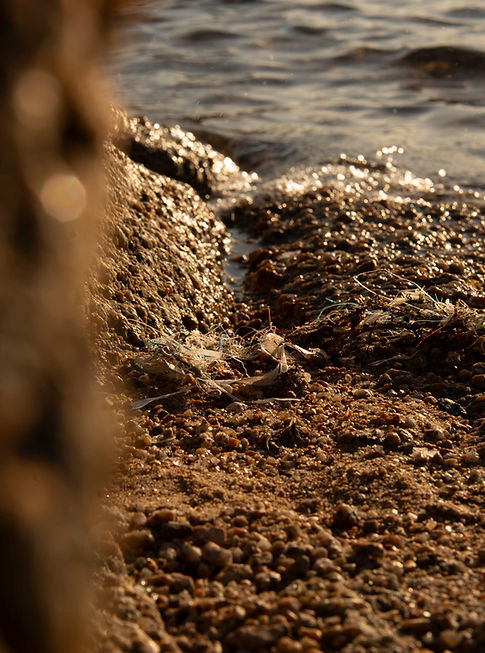
The empty beach shows that pollution stays even when no one is watching. It is a quiet proof that we often ignore the problem. Nature can exist without us, but we cannot live without nature.
The beach becomes a monument to indifference.